
This is the story of Charles W. Berkhouse. If you’re looking for a happy tale, one that will make you smile at the end with a fortunate feeling in your heart, you’re in the wrong place. This is the tragic story of a man’s miserable life, one in which the tragedy starts from the day he was born.
An orphan left on the steps of a nunnery, newborn Charles was found one fall morning wrapped in a blanket with a note pinned to the his diaper, two simple words scribbled messily “Unwanted child” on the back of a coupon for five cents off steak. The nuns sent him to their orphanage, a bare-walled, refurbished insane asylum rented out by the church for such events. It was fourteen years before an unwanted Charles would use a different return address, when he would leave the orphanage and get a job in an up-and-coming five and dime store in the city.
Years would pass, small promotions would come, leading him to his career as an underpaid traveling salesman for the same company he’d worked for his whole life.
As an adult, Charles eventually had it all, a wife, a child on the way, a good job, car, house with the white picket fence, everything a man in the 1940s could possibly want. Until that fateful day when Eunice, his wife, went into labor a few weeks earlier than expected.
They lost the baby; she would have been a beautiful little girl. They’d prematurely named her Elizabeth if she was a girl, Robert if he was a boy, Betty or Bobby. But little Betty never had even a minute outside of the womb. Eunice was devastated.
It wasn’t even two months later that Eunice was hit by a car, driven by another traveling salesman, a competitor of Charles. The driver was quoted in the daily paper as saying, “I was driving my route, I sell car brakes you know, best in the business, and I don’t even know where she came from. One minute the road was clear, the next…”
Charles was devastated. His life insurance company wanted to investigate the accident before they paid out, but Charles quickly told them to forget about it. He sold the house and poured himself into his job, staying in fleabag motels and dirty boarding homes on the road, never looking back. He carried his few belongings in a small suitcase he’d bought at a garage sale, which proclaimed visits to Paris, Madrid, Rome and a few other exotic places, none of which Charles would ever see for himself. All he would know were the small dying towns on his sales route, places long forgotten as time passed.
Every year, at some point, his route would bring him back to Middletown, New York, where both Eunice and Betty were buried. He would stop by a florists, pick up some cheap flowers, after all, his route wasn’t what it used to be, and stop by for a quiet visit. He wouldn’t speak or cry, he would just stand for exactly five minutes, timing it on his watch, and then move on towards his next appointment.
It wasn’t until his fifth visit that he first saw the dog, a golden blur shooting by in the corner of his eye. He spun, looking for it, and finally saw it standing directly behind a nearby tombstone. It panted and walked up to him slowly, trying to get Charles to pet him. Charles, being an orphan, never had a pet, even when Eunice begged him repeatedly for a cat every time a holiday came around. He just didn’t see the point.
And so, he reacted the way he always did when a pet wanted attention from him. He turned and walked away. After all, his five minutes were up, and he had to meet Mr. Moskewitz in fifteen minutes.
The next year, once again he found the dog there, begging for attention, and again Charles shunned the poor beast, leaving it whining behind him. As he left, he saw the caretaker and felt a need to complain.
“Sir, I find it extremely distracting and inappropriate that you allow your dog to just run around willy-nilly like that. This is a serious, somber place. Not somewhere for a dog to playfully run around and, ahem, do his business one can only assume.” The caretaker looked at him curiously.
“We don’t got no dogs here, buddy. Not allowed on the premises. Don’t know what you’re talking about.”
A year later, Charles once again found the dog near the grave, and once again ignored it. But this time the dog walked up and started nuzzling his shin, and he kept trying to shoo it away with no luck. Finally, he decided to look at the tag. It had one simple letter in quotes, “E”. He frowned and turned it over, looking for an address, but there wasn’t one. The dog followed him out, only to get him a scolding from the caretaker, who reminded him that no dogs were allowed in the graveyard.
The following year, he expected to find the dog again, and was not disappointed when, as he approached the gravesite with his yearly small bouquet, the dog, E, once again jumped out from behind a nearby tree. Charles walked up to it, let it sniff his hand and tried to pet it, at which E backed away from him. He reached into his pocket and pulled out a dog bone he’d bought and tried feeding it to E, who just backed away more. He left the treat on a small tombstone and went to his meeting with Mr. Meinheim.
Another year passed, and this time he was prepared with a leash, ready to capture this animal that was surely destined to be his companion in life. He imagined the dog going on his route with him, visiting parks and fields, playing catch, having strangers take their photograph in each town, and even though he was awkward with animals, he liked the sound of it. It was surely a sign that the dog was there every year, and that the caretaker didn’t recognize him as a common occurrence. As Charles walked towards the spot excitedly, playing with the end of the leash in his pocket, he realized he’d forgotten the flowers. He walked up and started looking for E, only to realize that the dog was nowhere to be found.


 discovered at a yard sale fully loaded, an unlikely find. She took out a small cloth and cleaned the lens, then reread the directions posted on the back of the camera itself. She was ready.
 She walked down the empty street, dragging her hand along a chain link fence, and looked from house to house, car to
  car, nobody to be found. She headed for the playground in the hopes that some parent would be there pushing their child on a swing, or teaching them to ride a bike. But when she got there she realized it wasn’t right. She relaxed on a bench and watched some kids play on the nearby jungle gym.


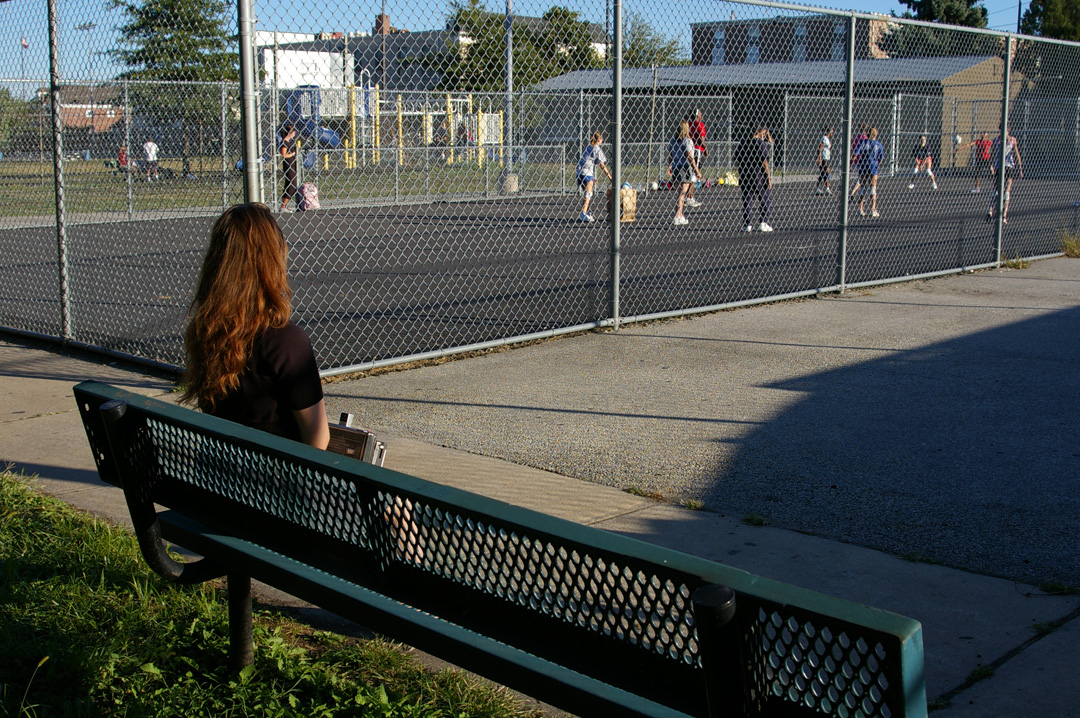 Photographs taken by me of model/makeup artist Sarah Maccarelli, whose work can be seen here. She was great to work with and was quite the actress, considering how happy and friendly she was.



 A Flash of Inspiration